Monday, October 25, 2010

Art Lesson: Graphite Pencils

Here is a little history and information I have learned about graphite pencils.


Important things to know about pencils:

Sharpening:
You can sharpen your pencils in a few ways. The easiest and most common is with a Pencil Sharpener. Like many tools, you get what you pay for. I like a pencil sharpener with a built-in container to hold the shavings. This makes it less messy. The problem with sharpeners is that they can loosen over time and get dull, thus being less effective. Electric pencil sharpeners seem to hold up well but if you are not near an outlet they are not practical.

Often I will use a knife to sharpen my pencils, especially when I work outdoors. Knives always give you a point that is sharp. For some people it is hard to work the knife just right without cutting off too much wood or graphite. This can also be a messy way of sharpening if you need a waste basket for the shavings. To sharpen with a knife you stroke the knife away from you, like whittling a stick.

Sandpaper can also be used to do fine sharpening of the graphite. I find this a bit messy and do not use this method much. I would rather spend my money on a decent pencil sharpener.

Problem - Graphite in pencil breaks often when sharpening
If your graphite keeps breaking as you are sharpening it, this is because at some point your pencil was dropped and the graphite inside shattered. Be careful not to drop your pencils on hard floors and surfaces.

Holding:
Your pencil should be held with what is called a dynamic tripod grip. The tripod grip means that there is equal pressure on the pencil from the tips of your thumb, pointer finger and middle finger. This grip gives the most flexibility while drawing.

I hope this information was helpful.
Keep using your Artist's Brain.

Wednesday, September 29, 2010

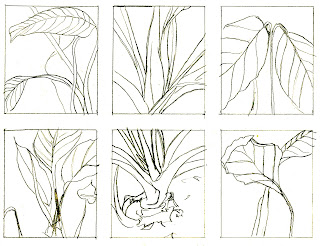
Art Lesson: Thumbnails, a Form of Protection


Where would we be without our thumbnails?  We would be in pain and misery, that's where we would be.  Our fingers would be wrapped in band-aids and nothing would ever get done.  And that is the same place we would be without thumbnail sketches!  Okay, maybe our fingers wouldn't be covered with band-aids, but we would be in pain and misery trying to complete an interesting drawing or painting.  Thumbnail sketches are very valuable to the botanical or representational artist.  It is in the thumbnail sketch (a small simple line drawing exploring composition and shapes) that:
- helps the artist explore the most effective and interesting view of their subject
- captures the energy of the first ideas behind the final composition
- defines the proportion of the final composition, and
- informs the artist what they need to observe, research or explore more deeply before investing lots of time into a project

I always first explore my compositions with thumbnail sketches, often done during boring meetings at work, and then expand them from there.  To see an example of a book cover developed from a one inch sketch, click here.

Saturday, September 11, 2010

Illustration: Book Cover - Bartholomew Makes a Decision

Here are images showing the progression for creating the cover for the first tale of The Book of  Bartholomew.  The first two sketches are my first ideas of what I wanted to paint: a plate of corn, green beans and kale.  The first is very rough and was only about 1.25" square.  The second image represents another plate of food with the words "KNOCK, KNOCK" on the cover.  This is because Bartholomew is interrupted during his meal by a knock at the door. All Bartholomew wants to do is find some decent food and once he sits down to eat he is interrupted by the phone and the door.

Then it was time to do some research. This meant enjoying a few meals of corn, geen beans and kale.  I cooked the kale once and the other time my girlfriend cooked it.  Hers was much better.  We cooked the food and then I went to work rearranging it on the plate to somehow match what I wanted to do.  I did not find my final composition, but it was fun and informative for the final painting.  The food was good.  I wish the green beans were from my garden.  Today I could pick them and use them, but when I painted this picture beans were not in season.

I used these images to layout the composition of the painting and made the first layer of paint on canvas. From there I built up the surfaces and colors to create a finished painting of a plate of kale, corn and green beans.  The cooked kale was the hardest to paint.  It was hard to get a focused picture of it as its edges are rather soft and difficult to pick out.
After completing the painting, I took the image to Photoshop and added the words KNOCK KNOCK and the title. This was a fun stage - turning a painting into a book cover

The next step was to create a background for the inside text pages of the story. Continuing with a food theme, I created drawings of forks and spoons. These images line the text pages and are faded behind the text. This was a very fun story to illustrate.  I like the idea of not showing Bartholomew or Gerald, but letting the reader develop their own physical image of the characters.

Monday, May 10, 2010

Art and Personal Salvation

Here is a quote from Becoming Human Through Art by Edmund Burke Feldman.

"The perfectionist impulse, manifests itself in primitive and child art as a result of the fear that raw, unadorned reality presents to the unsophisticated person. The child's art acquires a somewhat obsessive quality when he uses it to exorcise demons he cannot otherwise cope with. Contemporary artists, too, attempt to find in the reiteration of certain forms and themes a kind of personal salvation that life somehow withholds."

It seems so often that when I kick and scream against a stereotype about artists and why they create I eventually experience the very behaviors I rail against. In the movie New York Stories, Nick Nolte plays an artist who creates only when he is lonely for Rosanna Arquette's character. He needs the emotional turmoil of his relationships in order to fuel his art. I found this balderdash when I watched it as a young man in his twenties. Now, as a hopefully wiser man in his forties, I understand and have experienced the stress of relationships as a driving force behind creativity.

When I read the quote above about artists searching for personal salvation I normally would scoff a little bit. Art is art, there is no personal salvation to be found here. There is skill that can be fostered, there is vision that can be honed, there is support that can be won, but there is no personal salvation to be gained. Is there?

Is there more personal salvation to be found in creating art than in designing a car, selling a car, or building a car? Are others saved personally through carpentry, cooking, cosmetics? Is there a relationship between personal salvation and art?

Personal salvation does not come from actions you take. Personal salvation comes from accepting yourself while having a clear eye to your strengths and weaknesses. Isn't it a matter of perspective?

Yet here I am feeling a sense of personal salvation from writing stories for The Book of Bartholomew. Perhaps it is not salvation as much as setting something straight. There are times and experiences in my life I would like to revisit and do anew. I am allowed this opportunity through my writing. Perhaps this is a form of salvation -- perhaps it is a way of healing. I am not sure. But somehow I get the sense that soon I will be again experiencing a stereotype that I thought was ridiculous.

Monday, April 26, 2010

Completeness and Self-Expression

Excerpt from Becoming Human Through Art by Edmund Burke Feldman.

Why do I say the self is completed in the act of communication, that is, successful self-expression? Because I do not know in advance whether someone else will understand what I have made, or said or done. I await a response, I expect a knowing answer; I try to imagine how you will react by conducting a dialog with myself. But my expectations and anticipations are necessarily provisional until they are confirmed in a real, as opposed to a conjectured, reply. When you do in fact respond to my expression, you eliminate at least some of my uncertainty. Consequently, if you are a teacher, or a critic, or just another person, you have some control over my feelings of completeness or wholeness. You have the power to withhold your response or to respond inadequately with reference to my expectations. Or you may discover more in my expression than I thought I was saying. From this it follows that self-expression is at least two-directional; that we are responsible -- that is, answerable -- for each others self-development; and that self-expression in art is excellent or qualitatively superior only insofar as it exhibits the capacity to evoke excellent responses.
The unanswered expression of a self denies communion to that self and prevents it from becoming complete. The hyphen in the term self-expression provides the clue to its real meaning. It implies a self that acts and is understood.

I like this, except I do not necessarily think that the lack of an adequate response to an expression of self will prevent the self from becoming complete. Often it will drive artists to create better self-expression, so that the desired response becomes more likely. I have heard "no" too many times to really think that it has any impact on my becoming complete. I am complete whether people respond favorably to my art or not. Most artists learn quickly that attaching one's sense of self to their work creates a difficult road to follow.

Thursday, April 1, 2010

Oil Painting: Rush to Innocence

This is a painting, Rush to Innocence, I have recently completed. I have been working on this for quite sometime -- two years or more. It is about the giddiness and excitement children feel from seeing rabbits. An excitement so exhilarating they must start running. It would be great for adults to experience that emotion more often.

The rabbits belong to a friend who rescued them after their mother had been killed by a car. She raised three of them. Two are still alive more than two years later.

The image of the children is taken from a Dick and Jane primer from the 1950's. I took their clothes off to show the vulnerability of innocence and to play with the idea of innocence around nudity that is lost to adults. Yet, these two cherubs are running with excitement toward a symbol of fertility. Are they rushing toward the future? Or are they innocent to the future and just rushing because of their excitement about natural things, those in the moment and those yet to come? This is a 40" x 30" oil painting on canvas.

Tuesday, March 23, 2010

Living the Artist's Life - excerpt

I enjoyed reading this honest, maybe a little "catty", assessment of the wealthy in Living the Artist's Life by gallery owner Paul Dorrell.

But for the ones (the wealthy) who are awake, to connect with your art makes them feel more alive, even rebellious, especially after all the years of dull, repetitious, mind-numbing work many of them have had to do in acquiring their wealth. Unfortunately that kind of money-chasing often compromises growth, and can create an imbalance that is reflected by harsh acquisitiveness, appalling selfishness, and virtually no awareness.

When you meet certain of these people, you may see how their dignity suffered as a result of that chase, how all too often their goals were misplaced, weren't sufficiently rewarding, or were assigned undue priority. This may make them depressed, half-alive, or primitive in outlook, consumed by the misery of their greed. All too often this is the case. Their fixation with money likely screwed up their marriage, their kids, their own lives, leaving them drained of humanity, outside the feast of life, with them now trying, through art, to reach for greater meaning.

Whatever their individual natures, the rich do have a place in our system, and while it might not ultimately be as important as many of them think it is, it is still significant. Their businesses help create jobs, many of them passionately support the arts, and, when of the visionary sort, they do things for the underprivileged that you and I can only dream of. Regardless of who they are, and how benevolent they may or may not be, you must not judge them, you should never envy them, and you certainly should never allow yourself to be intimidated by them.

Be cool when dealing with the rich, be confident, but be humble. Like anyone, they are only looking for acceptance.