Showing posts with label Art Thought. Show all posts

Monday, March 26, 2018

AI Art and Dwindling Human Experience


Scientists at Rutgers University are programming AI to create art. After AI programs viewed thousands of artworks they were tasked to create Abstract Expressionist images. The images generated by the AI were then shown next to real artworks from Art Basel, one of the most prestigious art fairs in the world. People were then asked to differentiate the AI images from actual artworks by human artists. Long story short, viewers correctly identified the works by real artists more often than the works by AI. Yet, often, the AI images were indistinguishable from the images by real artists.

But then, “respondents were asked to rate how intentional, visually structured, communicative, and inspiring the images were. They 'rated the images generated by [the computer] higher than those created by real artists, whether in the Abstract Expressionism set or in the Art Basel set.'”

The catty part of me wants to question whether AI images looked more like real art, or Art Basel images looked less like real art? Art Basel is a bit of a carnival and lots of bad art is raised in stature by being seen with the good art. But, this is not the point of the article, nor is it the point of what I am most concerned about – meow.

This incident is one more step down a road that we have been traveling quietly for many decades, maybe even centuries. It is the devaluing of the human experience.

Of course, humans are the pinnacle of development - as far as we are concerned. So, of course, we would be the standard against which AI would be measured. AI is very beneficial in situations in which it helps humans to compensate for disabilities and deficiencies or makes a task easier and safer. But there is another side to AI - creating an alternative to humans.

It is interesting that all the articles I have been reading focus on the timeline for improvements to the AI. They ask where is AI on the road to developing true imagination and how long will it take to be indistinguishable from human creative thought? But none of them ask what the impact is on humans. What happens to humans if a completely separate entity is created that makes human expression no longer unique, or necessary?

As someone who is engaged in expressing his human experience through his art, I always find it puzzling when people want to disregard the human experience. We see this continually in the world around us. We have fake news that is not based in human experience, but manipulated messaging. We have Facebook friends and communities instead of investing in personal relationships and engaging in local human communities. We watch other people's (fictional and non-fictional) experiences on television instead of creating our own. We have alternate reality machines that can put us into a completely convincing alternate world. On top of that, we do a lot of self-medicating via alcohol and drugs. It is as if we don't want to be here. As if we don't want to be ourselves.

I know life is hard for many people and I don't want to make light of that. My life, at times, has been very difficult. But I relish the personal experiences of raising a daughter, being involved in my friend's lives, and being intimate on many levels with a partner.  I enjoy having a mother and sister that live close so we can share new experiences while reminiscing about old. I enjoy creating something on a daily basis. And I appreciate the eventual results of wrestling with the difficult times.

Now, to see an AI program creating “art” is one more example of negating these human experiences and there expression. Yes, Mark, but people find the AI images more engaging. Doesn't that make the AI art more valuable, more...art? This is tantamount to saying news sources are credible because they have stories that appeal to your opinion on issues. We have flipped the dynamic of human experience. Instead of observing the world around us and growing from its alternating between challenging us and supporting us, we expect to impress our opinions onto it so our reality is not challenging. What we are doing is creating a small homogeneous bubble around ourselves thinking it will protect us from pain and struggle. My friend, Barbara McAfee, in her book Full Voice, asks the question, “when did we decide that being anything less than our full selves would make us safer?” It's a great question.

My human experience is not so objectionable that I want to continually run from it. Society-wide, that approach is a race to the bottom, a marathon to a world that will not allow us to reach the finish line. I am trying to live in a world where we value the expression of our full selves instead of leaking our self-loathing into objects meant to replace us instead of amplify us. I want my life to be an oil painting of substance instead of an empty illustration of what I had hoped for.

So, for the foreseeable future, I will keep painting, putting my experience into canvas and panels. I believe that art is an object. It is not an image. Artists imbue their substrate with an energy that lives on and emanates into your home when you hang it on your wall. Then, you add your energy to the art by interacting with it on a daily basis and providing a deeper experiential meaning. In the end, the work has been a conduit for energy and intention, for building memory and knowledge, for sharing experience and meaning, for weaving together the strands of humanity that create a better self.

At some point we will have to put away our AI, our toys, and our distractions and value our experiences, expressions and who we are at our core, if we are going to make it to that finish line.

__________________________________________


Here's another interesting article about the history of AI paintings, which have their beginnings in 1973: https://newatlas.com/creative-ai-algorithmic-art-painting-fool-aaron/36106/

To see my non-AI paintings, visit markgranlund.com.


Wednesday, March 7, 2018

The Obamas, Neanderthals and Art

There were two major news stories about paintings this last month. First, it was fun to see paintings being the center of nation-wide media attention with the release of President and First Lady Obama's portraits. The first African-American couple in the White House had their portraits painted by African-American artists, the first to do presidential portraits. The artists are Amy Sherald and Kehinde Wiley.

To begin with, these paintings are meaningful on that level alone. Even if these were the same type of portraits as their predecessors, these would have additional meaning because of who the artists are and who sat for them. But, in addition, each of the artists took the portrait format in unconventional directions, which fits with their previous works but not previous presidential portraits. They were chosen by the Obamas precisely because they would bring new life to a rather formal and predictable tradition.

President Barack Obama's portrait was painted by Kehinde Wiley, an artist who for many years has been painting African-American people in what would be considered traditional depictions of the aristocracy and the gods. They are very dramatic and often very large.


Although President Obama's portrait certainly stands out amongst the portraits of previous presidents, it doesn't "wow" me. Mr. Wiley has always shown a great ability to paint hands, and I love the President's hands in this portrait. Real bone and sinew under the skin with amazing tonality. The rest is convincingly painted, but to me seems a little more flat, a little less lively than the hands.

That said, paintings can be a completely different experience in person and I would love to see these in person.

Michelle's portrait is painted by Amy Sherald. An artist that has just recently returned to her painting after dealing with family illnesses, including her own, for many years. Ms. Sherald's portraits tend to the minimal in emotion and composition. She paints her subject's skin in greys and does not create lifelike likenesses in terms of detail. Her subjects are simplified, becoming almost interchangeable from portrait to portrait. The dress is a very important part of this portrait compositionally and in terms of meaning.

The dress is large, First Lady Obama could be sitting on a high stool underneath it. The colors and patterns represent different ideas. But, quite frankly, I read about them and immediately forgot and didn't care. Really... I read a very nice, rather long, article about what Ms. Sherald tries to achieve in this work, but if I have to read that much to understand what an artist is doing symbolically, I just don't care. As an image, I really like the painting. I like it better than her husband's. The solid colors are soothing and reassuring. The portrait is strong and depicts someone who is nobody's fool, yet there is an elegance to her. I think the portrait, within Ms. Sherald's style, captures Michelle, but it is a somber side of her.

These portraits will break the tradition of the staid traditional presidential portrait, which is good for art. It gets to a point with certain genres where the artists are no longer taking chances and being human, but become a factory trying to meet expectations. A shaking up of ideals is good for art and for people. It challenges the status quo and pushes us to consider things that have become Cannon. Limiting our idea of what is "right" to what is acceptable never leads us to our full selves, never leads us to something that makes us better humans.

As could have been predicted, there are people who do not like the portraits simply because it is the Obamas. When it comes to the Obamas, there are some people that will never be happy. Many of them are racist and don't want to accept that a person with dark skin can be their equal... or even their superior. They can't accept that this country is only as great as it is because of the labor and sacrifice of African-Americans. Somehow they think this is a challenge to their own contributions and turn around and do nothing but belittle and deflect the accomplishments of people with darker skin.

Another art story out this month is about cave paintings in Spain. Three caves were discovered to have paintings on the walls that predate Homo sapiens' arrival to the peninsula. This means that they were painted by Neanderthals. Until now, Neanderthals were considered to be cognitively inferior to Homo sapiens and there has been no known example of Neanderthal art. But the art in these caves, in particular in that they have some complexity to them, show that Neanderthals may have had the same cognitive abilities as Homo sapiens. These paintings pre-date any art by Homo sapiens by 20,000 years.

Cave painting in Spain

One of the things that I love about life is that, through art, not only can we challenge our understanding of people today and set the future in a new direction, but we can also make discoveries from thousands of years ago that can change our understanding of the world. Until now, it was thought that Neanderthals went extinct because they were not as smart as Homo sapiens. For hundreds of years we have had this negative view of Neanderthals simply because we "won" on evolutionary terms. We have turned Neanderthal into a derogatory name for someone who is dumb and brutish. Other studies are also coming out showing that Homo sapiens and Neanderthals interbred more than previously thought. Wouldn't it be like Homo sapiens to have inherited our culture and refinement from the Neanderthals and then turned around and belittled them and gave them a dirty name?

Tuesday, February 13, 2018

Art is Not My Purpose, It is My Vehicle

I'd like to be self indulgent and share why I have become more introverted as I get older. Lately, I see more articles and posts on social media about how this world really has no meaning, that people have no preordained purpose. I think these two things are inter-related.

For the last couple of decades I have defined myself as a father first, then an artist, then by my day job and then whatever else. My daughter has become an independent young woman, living on her own in another country. My first self-definition is needing less attention and the needs of my second self-definition are growing. It keeps knocking on the door and insisting that I finish something that I started years ago.

I have been drawing, and getting recognized for that skill, since 3rd grade -- Mrs. Shore's classroom. I did quite a good job of drawing a map of the United States and recreating the cover of an album of Sleepy Hollow stories by Washington Irving. My fellow eight year old schoolmates also seemed to like the clay creatures I would create. There was a girl in the class who was also a good artist -- I wish I could remember her name. She reminds me very much of a friend I have now, named Aleta. This pseudo-Aleta, as I mentioned, was also very good at drawing and it seemed like her and my art were considered the best in the class. More often than not, my classmates tended to respond a little more positively to my work. I liked that. It felt good to be considered the best at something. I drew a lot at home and did as much art as I could at school.

When not making art I would hang out with Peter Goodwine, David Hooley, or Michael Iannacone and we would catch frogs, light firecrackers, build forts and tramp about the woods of Northern New Jersey. It was a good time.

In high school, I continued to define myself as an artist and was recognized as one of the leaders in my grade. So much so, that in my senior year the art teacher told me to sign up for any art class and then he would determine my assignments with me - in any medium I wanted. Basically, every class was an independent study. I would hang out with Mark Johnston, Jim Pappageorge, Brian Huck and Ken Hooten. We would drive around, listen to the Cars, play soccer, play pool in Brian's basement and laugh A LOT! It was a good time.

In college, I continued to be a leader with the art department crowd. I won awards, hung out with cool kids and had a good time. In graduate school I was considered a leader in my class and was the first student ever to win back-to-back graduate fellowships in the department. I was living in New York City and met my future wife. It was a good time, although I must admit that living in New York City in the mid 1980's was challenging. There was a lot of crime and I left The City not thinking much of people, in general.

I got married soon after graduating, moved to Minnesota to teach art at my alma mater and a few years later became a dad. I kept making art, but it took a backseat to my relationships. I was very active in my community. It was a good time.

In mid-life, things got harder. The marriage fell apart. Having a proper studio space in which to make art disappeared with the marriage. There were several years of trying to parent while putting the pieces back together. Friends changed, too, as they dealt with their own divorces, needs, passions... or addictions. We scrambled it all up and then tried to put things back together again. Some friends are still here, but many new friendships have developed. Over time, the things that were important when I was younger ended up not being that important. What I look for in a friendship or romantic relationship has completely changed. Through it all, the swings this way and that, I have come to the decision, like many in our society, that there is no preordained purpose to my life.

Art has always seemed to be part of my sense of purpose. But after a lifetime of not making a living at making art, of art taking a backseat, of people not valuing my subject matter as much as me, art becomes slightly hollow in its sense of purpose.

Now this seems like I should be depressed by my experiences. It seems like maybe I should give up art. But, I think, truly, it has taken me a lifetime to hit rock-bottom and now I can build up again. When I say "rock-bottom" I don't see that as a negative and it doesn't mean I am depressed. There is a point in life where you have to live with your true self and accept it so that you can go through the next doorway. I am on the threshold and I can't deny myself what is ahead. It is happening and I am letting it happen, gladly. Art is not the purpose of my life, but I have been making art for so long that it has become the vehicle for moving myself forward. When you realize that there is no preordained purpose to life you, hopefully, realize soon after that meaning and purpose in life is dependent on no one but yourself. With this wisdom I can hold introversion and focus in my one hand while holding relationships and community in the other. It almost seems like the threshold is moving toward me now.

I don't know if anyone will understand what I am writing, as I said, I was going to be self-indulgent. But, I am on a journey and I think sharing it is better than not. I think it is sufficient for you to know that art is very deep for me.

Friday, January 19, 2018

Everything, and Everyone, Has Their Time

Leisure is not the privilege of those who have time. It is the virtue of giving each thing you do the time it deserves.
– Brother David Stendhl–Rast
I came across this quote on another artist’s webpage and it struck me. With the new year ahead of us and the old one disappearing in the rearview mirror, I have been thinking about time. This Monday is the Blooming Saint Paul Awards ceremony. The Blooming Saint Paul Awards is a program I set up several years ago for the Saint Paul Department of Parks and Recreation. It’s a fun evening of handing out awards to gardeners who do not get enough recognition for making our city beautiful. Last year was the first year that I was not running the program. I did emcee the event for fun and to help with the transition to a new coordinator. As I think back, that event seems a very long time ago. Much has happened with my switch to a new employer and the old job, and its responsibilities, quickly were put in the past as my new responsibilities took over.  Just before last year’s ceremony, the country transitioned to a new president. For some reason, that event does not seem nearly as long ago as the Blooming Saint Paul Awards. In fact, it seems much closer in time than several more recent events in my life.

I am always fascinated by time and our perception of it. Events fold one into another and we select the ones to emphasize and de-emphasize, consciously or not. I am one who is often a little late for events and things. I am not clock oriented. I am task oriented. If I am not quite done with a task and it is time to go I do not immediately stop, rush out the door and come back to the task later. I finish the task. Sometimes the task is just a stage of a larger project, like gluing together wood for stretchers. I might delay my next activity to finish the stage of gluing so I come back later to assemble the stretcher. But, if I try to leave before I have glued everything that needs gluing, my brain does not pull away from the task until it is complete. Some people might call this OCD, but the reality is that I am not clock oriented. Everything has its time and I don’t mind allowing the time necessary.

I think this is ultimately important, and very difficult, when it comes to dealing with people. An interaction with a person, in order to respect that person, should be allowed the time it deserves. I am a planner. My mind is always thinking about the next task; what would be the best way to approach that activity, what realistically is the time needed to transition, how will the "now" effect what is happening later, etc. Sometimes it is hard to turn this off when talking with people. It is sometimes hard to be people oriented when you are a task oriented person, just like clock oriented people tend to rush interactions.
I have always been task oriented. Sometimes, to others, it seems like I am very efficient with my time. Which I can be. But being task oriented can be a bit troubling - I am often late when meeting people, I lose track of time, my dog really starts pestering me, and until the next activity has engaged me I can be distracted. 

In my mind, making art has been an activity that has fostered a sense of taking enough time. A painting is not done until you have spent enough time on it. It is a dialogue and the conversation is never over until there is nothing left to say. The conversation doesn't end because of awkward silences, or because there is a subject you don't want to brooch, or because of something that happened last time you painted. The conversation quite simply continues until the painting is done. Often the painting doesn't stop talking, it just goes on and on for a very long time. Then finally, there is silence. The silence of completion. No more words, no more paint strokes, no more tasks that need tending. It is a good feeling to know that you have given something as much time as it needed. It is rare. 


I don't make New Year's resolutions. But I have a suggestion for myself for this year: to give each thing that I do the time it deserves, to give each person I interact with the time they deserve. I'm not in a hurry for 2019 to get here, 2018 just started. There's still a lot of time.

Sunday, May 14, 2017

Let 'Em In

I like to listen to music when I am painting.  Lately, I have been enjoying listening to the best of the Beatles after they were done being the Beatles. I have compiled the four "Best of..." cd's of John, Paul, George and Ringo. These four musicians really are amazing. Amazing as individuals, but what strikes me is the consistency of message from the years of being the Beatles. There is the usual stereotyping that John has the heavy political message, Paul sings about love, George is spiritual and Ringo is, well,... just Ringo. But that is not the case when you listen to their music. Even after breaking up, the four of them continued singing about love, community, togetherness, forgiveness, and the positive possibility of what could be.

Yes, I am aging.  I am in my fifties and am a Beatles fan. I am of my era, and I am at a stage in life where I am questioning my experience so far. There is much talk about the Woodstock generation (a little older than me) and a general sense that they "sold out" -  gave up on their idealism as they aged. Some say they did even more, that they undermined their own revolution.

I'm not sure my generation had ideals. We came of age in the disco/cocaine sniffing/clubbing days of the late seventies and early eighties - not that I or most people in the country had that experience.  That apparently was what was happening in all the cultural hotspots on the coasts. Not a world full of ideals - hedonism was the theme of the day. At the time, I was too shy and fearful of life to notice what it all really meant. But I do know that our culture has not had spokespeople like the Beatles since their loss. When I hear current cultural stars talking with a communal perspective it seems canned, groomed to be acceptable instead of being an antithesis to the larger culture (I will acknowledge Ani DeFranco here as being way cool). They are not in-your-face with their entire being. The Beatles started as nice boys wearing suits and singing about love. Eventually, they became these guys who grew their hair long, wore outrageous clothing, talked tongue in cheek about their fame, sang about a backward social order and insisted on having their experience on their own terms. To see them, you could tell they were an antithesis to the larger culture. But this was the pre-glam era, it was a little easier to be noticed for wearing outrageous clothing.

I think about meaning, as an artist. Am I simply making paintings for an audience or am I painting in a manner that reflects and encourages our society? I was given advice many years ago by a painting instructor: landscapes sell. Of course, I refused to paint landscapes. Instead I painted about mass-murderers, riots and missing body parts - in the guise of landscapes. Nothing sold. Hmm.

Then I painted about oppression and the holiness of life. Nothing sold.
Then I talked about "The Land" by making artwork with objects from nature. Nothing sold.
Then I started painting botanicals.  I sold a handful and then nothing.
Then I started painting about food. Nothing sold.
Recently, I've been painting landscapes.  They've been selling. Who knew?

I do not worry if I am "selling out" for making landscapes.  I am painting about the experience I have in nature, in particular in Northern Minnesota. To me, it is related to love.  It is something that touches my soul, like a waking dream - Ah! böwakawa poussé, poussé. More than anywhere else, the North is where I have sat back and thought there is no where else in the world I would rather be. There is no time, days are meaningless. Anger is futile - it solves nothing! Love is all around. Not romantic love, although sometimes that is there, but love of all that is. Perhaps it is more aptly described as oneness. There is no contention, no division, no competition. Problems simply become annoyances, annoyances become a puzzle to solve or a fleeting moment to be ignored. Healing outweighs hurt. A broken heart gets to beat uninterrupted. The past is not released, but becomes the foundation on which all the good of the day grows. Breathing, itself, becomes a meditation.

My quest is to hold this perspective in my mind when I am in the City, when I am in the midst of my daily life. My vehicle is my art and the contemplation associated with this task. The Beatles help me hold this perspective with their music and with who they were. The following are excerpts from some of their songs I find particularly helpful. A year long meditation could be done on the first line of John's lyrics below. How would it change your life to come to truly know that "love is the answer and you know that for sure?"

John Lennon - Mind Games
"Love is the answer and you know that for sure.
Yes, is the answer, and you know that for sure.
Yes, is surrender, you gotta let it go."

Ringo Starr - Fading In and Fading Out
"Tell me, why we're here?
All we really need is love
And when I disappear
I pray that I have left enough

Fading in, fading out, isn't that what life's about?
First you're here, then you're gone
Still the world goes on and on."

George Harrison - Isn't It a Pity
Isn't it a pity
Now, isn't it a shame
How we break each other's hearts
And cause each other pain
How we take each other's love
Without thinking anymore
Forgetting to give back
Isn't it a pity

Some things take so long
But how do I explain
When not too many people
Can see we're all the same
And because of all their tears
Their eyes can't hope to see
The beauty that surrounds them
Isn't it a pity

Paul McCartney - Let 'Em In
"Someone's knockin' at the door
Somebody's ringin' the bell
Do me a favor
Open the door and let 'em in."

Thursday, January 21, 2016

Art Thought: Has 100 Years of Modernism Ruined Art Schools?

I've been reading a lot of art history lately focusing on 1850 - 1985: The Era of Modernism. Having taken art history classes in college and graduate school, I was aware of the development of Modernism, but what I had forgotten was how early it began. I had some sense that Modernism was a reaction to the societal chaos that led up to the first and second world wars.  But it began much sooner with developments well underway in the 1860's - 1880's. The recent Delacroix exhibit at MIA is trying to even establish Delacroix (1798 - 1863) as the first influence on the artists who would establish Modernism.

One of the main tenants of Modernism is the throwing off of the power of the academies and establishing the individual artist's vision as the sole guiding force in creating a painting. The art academies taught a way of painting that insisted upon certain processes and subject matter when creating a painting. In particular, the Paris Academy of Fine Arts was very conservative and prioritized categories of art expecting realistic but romantic paintings. Winners of the Paris Salon (works for exhibit were chosen by the academy) were almost guaranteed to have a successful career and receive commissions from the government and wealthy individuals. Although some would find this stifling (such as those who created Modernism), the academies did teach the medium of oil painting, composition, the use of allegory and symbolism, etc. Cezanne, Manet, Whistler, Gaugin, van Gogh, etal. took painting in a different direction, but had grown up in an art environment dominated by the academies.  They were well aware of what was being taught in the academies.  Many attended the academy and knew other artists who had completed their academy training. Plus, they had attended the Salons created by the academies, and entered their paintings. At the Paris Salon of 1863, the artists that were rejected from the exhibit created a stink and Napoleon III let them have their own show in another part of the Palace of Industry to let the public decide if they like the art.  And thus, the avant-garde gained acceptance with the public and the rest, as they say, is history.

And now we come to today, a hundred and fifty years later with Modernism having been fully established for more than one hundred years. The official academies of fine art are long gone and been replaced by art departments in schools that have several departments and disciplines.  There are some private ateliers and schools called art academies, but there is not the hierarchical structure that is attached to government and private commissions. The ateliers and academies of today are simply teaching a formal technique.  If you do not do well in art school you will not lose commissions. If you excel at art school you are not guaranteed any success in your career.  Things are very different.

The structure of the academies has been replaced with the individual artist having to find their way to success by creating a compelling body of work. Compelling is the operative word here and it runs the gamut from Thomas Kincade to Karen Finley. I'm not going out on a limb stating that the difference between Kincade and Finley is greater than the difference between any of the early Modernists and the artists of the academies that they rebelled against.  There is little in our larger society from which to create a solid base of skill in making good art. Artists actually asked for this situation. Of course, the early Modernists already had a solid base for understanding painting because the academies existed and the results were all around them. But now, generations later, I fear a solid base for crafting good art is not available.  There is a craft to art.  There are media to be used and they should be used in a manner that supports the overall direction of the idea behind the art piece.  Yes, there is technique taught in art departments, but the work I have seen lately by young artists shows a lack of understanding in using their media.

Part of the problem is that artists can now use anything to create art, not just paint and canvas, or granite and marble.  There is no limit to what you can use, even taxidermied animals, computer operated light systems, and your own body. No small group of teachers at a school will know all of the available media and how best to use it.  In these cases, all a person can teach is to be a stickler on presentation and hope the student takes care.  But I'm afraid that students get teachers out of their comfort zones - ah, if only there was just one to three painting techniques to teach instead of an infinite number.

And then there is that aspect of needing to be compelling so that you can be supported by grants.  In my day job as an Arts Coordinator with the City of Saint  Paul, I have seen numerous people receive grants and only afterward contact the City to claim that they have received money to create an art piece on City property, after all, they wrote it into the grant proposal. More often than not, these artists don't have any real idea how to use their material or how to work with the space which they proposed.  But the proposal was so compelling!  Its as if artists are rewarded not for the completion of a successful piece of art, but for coming up with a compelling idea that may never actually get enacted or created in a way that will allow it to last for any significant period of time.

I have also been visiting art exhibits around the Twin Cities over the last couple of years and have been appalled at a lack of understanding of material and technique by younger artists.  I was most appalled by an exhibit for emerging artists by a local foundation.  The lack of understanding about material and process was astounding in a majority of the artists who had won the grants and had a year to develop the work - with support.  But, obviously, their ideas were very compelling when they wrote about them.

Now, in fairness, I will admit that I am a much better painter now than I was in my twenties. Even better than when I was in my thirties.  I also will confess that I have had a hiatus away from oil painting for a few years and as I am getting back into it I am realizing that I don't know much about it.  I had been previously painting with oils for years before my hiatus, but somehow, it seems now like I know nothing.  I don't just mean this as a proclamation to make me look humble.  I really feel, when I am working on a canvas, that a whole new world is opening up to me that I never was aware of before.  I do wonder where my brain was at when I was in school all those years ago. Oh yeah, I was scared I wasn't... everything.

I have no solution to this problem but to encourage artists to research their materials and technique and to learn from others who are a little further down the road, cuz' lord knows, there isn't an academy or a culture drenched in art to help you. 

To encourage artists to greater art making, I submit to you the following paintings that were created before the artist celebrated their 30th birthday.  Many of these were made when they were 25 - 27 years old.
James Whistler, Symphony in White No. 1

Anthony van Dyck, Genoan hauteur from the Lomellini family


Eugene Delacroix, La Pasion Griega

Auguste Renoir, Lise Sewing
Claude Monet, The Picnic (fragment)

Camille Pissarro, Deux femmes causant au bord de la mer, Saint Thomas 


Georges Braque, The Olive tree near l'Estaque

Pablo Picasso, Les Demoiselles d'Avignon
Eduard Manet, Música en las Tullerías

Alfred Sisley, Lane near a Small Town


Thursday, July 23, 2015

Art Thought: What Kind Of Artist Are You?


You hear it constantly in articles about art that you need to establish a regular schedule or routine when making art.  That is true.  If you don't regularly make art, it eventually will disappear from your life. But all too often, creating a regular routine can feel confining and actually become a barrier to making art.  I think it is more important to realize what kind of artist you are, then from there you can discover what kind of schedule you are able to maintain.

What kind of artist are you?

The Dabbler
You are a person that dabbles at art.  You enjoy occasionally taking classes and, when there is time, you often find yourself pulling out your art materials and making something.  You probably have a busy life (maybe there are kids) and you don't identify yourself as an artist.  There is something else you do that you identify with more – maybe your job, maybe parenting.  This is a perfectly acceptable place to be.  You enjoy making art and, at times, it is really satisfying and helps you think about yourself and your life in a different way.  These are all great things.

Pitfalls:  You think that you should be doing more with your art... which leads to guilt... which leads to bad feelings associated with making art... which leads to not making art... which leads to not feeling fulfilled.  Although, as an artist, I want to say “yes, you should always want to do more with your art,” I also understand that there are times to be a Dabbler.  For a time, I considered myself a professional artist, but then I had a kid and several years later I had a divorce.  After both events I basically became a Dabbler in art.  Sometimes life is too busy to make art the primary or secondary activity.  That's OK.  It is especially important to understand where you are at in your life and what you are capable of.  There is no shame in focusing on other areas of your life when you need to.

Joys:  You are making art and you are keeping creativity in front of you as a means for achieving happiness and self-identity. I have had several friends who have studied art in school, got a degree and then never really made art again.  If you are still dabbling away, you are doing as well or better than many in terms of having art in your life.  There is no one way to do your life – there is only your life.  Do the best you can and be happy because you are being the best you can be and you still get to do something you enjoy! Make art when you can and share it with others.


The Enthusiast
The next type of artist is the Enthusiast, someone who is actively making art on a regular basis by attending classes and making things on their own.  The Enthusiast is called just that because they are very enthusiastic about what they are doing and like to share it with others.  They try to get friends to take classes with them. They have tried many different media and are starting to settle into one or two that they really enjoy!

The Enthusiast tends to give more time and resource to art than the Dabbler and might start to think about becoming an Artist (see below) because they enjoy making art so much.  Yet, they are still creating each project as an individual project and their work is inconsistent in many ways.  An Enthusiast will still have another way of identifying themselves other than being an artist – it is not yet a primary activity of their life.  They might still be identifying themselves by their job, or as a parent or some other role.  Art is important to them, but again, not primary.

Pitfalls: Enthusiasts think they are on the verge of being a Professional (see below), yet have no idea of what that takes and how to get there.  They over-estimate their talent and under-estimate their ability to position themselves to become a Professional.

Joys: You are becoming good at a technique or media, are feeling confident about your ability and are excited with each new challenge.  It is an exciting time do be an artist and this feeling can carry over into other areas of your life.  How awesome is this!


The Artist
Well, this is what you wanted to be – an Artist. Congratulations, you are here!  Art is a primary activity of your life.  You may still, and most likely, have a job for making income, but art is more important to you and preoccupies much of your mental space and what spare time you have.  You have a fairly regular routine for creating art and your work is following a path.  You have become very good at a technique or two and have created a series of work. You have started to craft a style to your art, making a small body of work that has consistency to it.  You are in a show now and again, sell some work from time to time and may have received a grant or two.  You might actually make enough money to file taxes on your “art business.”  It is a struggle at times, but a very satisfying struggle.  You have other artist friends and you rely on each other to learn about grant and exhibit opportunities and commiserate with each other.

Pitfalls: Wow, man, this is hard!  Where's the money and the fame and the.. well, the fun! Now, instead of having one job you have two and one of them doesn't pay for itself.

Joys: You are becoming wise.  You are exploring parts of yourself that you have never given voice to.  You are becoming very proficient and confident that you can take an idea and incarnate it.  Others recognize you as a talented artist and respect your experience.

The Professional
What, there's another step?  Yep.  The Professional is not only known by other artists, but is know by the established art community: art dealers, gallery owners, museum curators and many individual collectors.  Selling art is a common occurrence, even if you're not quite making a living at it.  Your “other” job, if you have one, is a vehicle for you to pursue your craft via networking, creating opportunities or by providing resource (other than just money).  Your daily activities and interactions are focused on your art.  You are doing outreach to other venues, perhaps in other cities and everything is working toward creating income or opportunity for more resource.

Your work is consistent.  Any work done outside your main body of work is for fun or to explore a new avenue in order to inform your current work. Many people know your work when they see it.  The theme of your work resonates with established historical references, yet takes them in a new direction that resonates with current sensibilities in the arts and your societal culture.  You understand that your art is not only reliant on you, but it takes several people to put your art in a position so that it can support you – so you can make more.

Pitfalls: Some people will just be trying to use you and then cast you off.  Others will be jealous of you, even if you don't actually make a living from your art.  You most likely will not be making an extremely comfortable living, or you will, but only for a short time. You have to be a business person as well as an artist.

Joys: You will meet some of the most amazing and giving people who absolutely love art and see your work as being worthwhile, maybe even a little inspirational.  You can take pride in the life you have created, even if it isn't quite what you thought it would be.  You are making art on a regular basis and your creative energies are consumed by it. Yeah,... you are one of the few.


Every artistic person will be in more than one of these artistic levels during their life, if they actually keep making art.  As mentioned before, there are stages of life wherein you will be able to maintain your level of engagement or you will not.  It is okay to not focus on art for awhile if you need to focus on other things.  Even when you are a Professional, there are other parts of your life to maintain.  I think the important thing is to be able to take stock of where you are at and what you see as possible for you.  If you know your current level of engagement is all you will be capable of for awhile, be comfortable with it and have appropriate expectations.  If you feel you could move up to the next level, take stock of where you are at, what you will need to do to get to the next level and make a plan.  Hopefully, this bit I have written will help you get there in a realistic manner.

Wednesday, July 8, 2015

Art Thought: Why I Paint Food

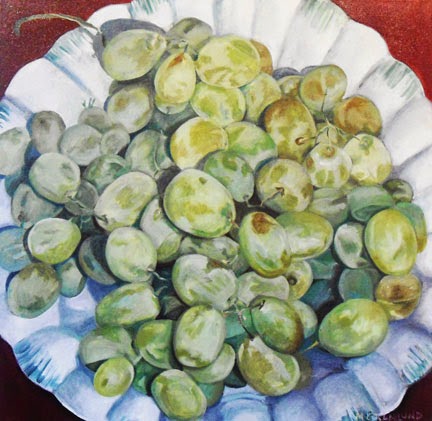
My latest series of paintings is of food. Some of the food is in good shape and ready to eat, while some is rotten or moldy or the image is of the part of the vegetable that we throw away.


I am creating this series for several reasons.  One reason is that I am exploring food as an object. How do you create the pattern of carrot greens laying over each other?  What is the true color of an eggplant that is rotting? What does it look like when a tomato ages and leaks juice onto the plate? So often we purchase a vegetable and then immediately place it in our refrigerators without really looking at them – appreciating them for their physical qualities.  All too often, I have the pleasure to observe the changing shape of a rotting vegetable I find in the back of my refrigerator.

Another reason I am painting food is it is fun.  Food is fun.  On days when I do not have to be anywhere, I like pancakes, sausages and eggs for breakfast.  Making pancakes makes me feel free, like the day is special.  I'm not sure if I have ever seen a painting of pancakes before.  They are a fascinating thing to paint with the varying tones of brown in the middle and the batter-colored edge of the disk. And eggs, how do you show the color of egg yolk underneath a thin layer of egg white? I find certain foods to be fun, and the challenge of painting them fun as well.

I also paint food because it is such an intricate part of being human.  We eat, on average, three meals a day. That is a lot of food, a lot of decisions, and at times, a lot of cooking.  Our bodies depend on that food.  Most of the cells in our bodies replenish themselves every few months.  Where does the nutrients, vitamins and proteins come from to create those cells?  Food.  There is no way around it. If you want to live healthy, if you want strength and vitality, if you want balance in your life, you need to eat food. The healthier the food the better your body will work.


But our relationship to food has become so complicated, because it is such an intricate part of being human.  We have a tendency to think of food as something separate from ourselves.  There is a sense that as long as we put something in our bellies, especially things that taste good or make us feel good, our body will use that to maintain itself.  But many things that we consume can not be digested or used by our bodies.  Some things are actually detrimental to our health – even though someone else is telling us that it is healthy.  In these paintings I am also exploring this complicated relationship with food.

What is the difference between eating fresh caught rainbow trout and fish-sticks?  Physically, aesthetically, and socially?  Why do we need an apple, the Arctic Apple, that does not brown when cut?   Why do we need to pump chemicals into our environment in order to produce food?  These are all questions and concerns that also inform this series of paintings.


I would love your feedback as I display images of my paintings here and invite you to come to any shows I will have.

Wednesday, February 4, 2015

Art Thought: Representation or Life?

As I paint the mold on an eggplant, I am thinking about that point in a painting when you choose between trying to accurately represent what is in front of you or putting your own energy into your subject.  Often, when I focus on being accurate I find my paintings become dull and lacking life. There is a fine balance between capturing tone and hue while pushing values and intensity to better represent form or volume.  I think it is similar to the dilemma of trying to locate a subatomic particle and measure its mass - you cannot do both at the same time.  It is hard to see what is in front of you accurately in the 3-dimensional world and recreating it in a 2-dimensional setting.  And how do you paint mold, anyway?


Wednesday, January 7, 2015

Art Thought: To Sketch or Not to Sketch?

Someone asked me yesterday if I sketch out my paintings first?

My answer was "no" because we were talking about oil paintings.  I do not sketch out my oil paintings ahead of time but sketch as I go, drawing one or two shapes, blocking them in, drawing the next couple of shapes, blocking them in, etc. until the entire composition is complete.  Of course, with oil paint, you can change things as you go.

For my botanicals I do several studies first and sketch the final detailed composition on the watercolor paper. For general watercolors, I do a combination of the two styles, sketching out  large parts of the composition with my watercolor brush and a neutral color before beginning to block in areas.

Wednesday, December 31, 2014

Art Thought: Someone is Knocking at the Door

I wonder when to follow an established style and when not to.  My current painting is beginning to look like a Thomas Hart Benton painting.  Should I follow his style as I try to solve problems within the piece?  Should I ignore this style? Should I let Thomas Hart Benton in to my party?

1/2 Hour Later:  OK.  So I figured out that I can use THB to get down the structure in the painting.  After all his painting style captures shape and value really well. The area where the greens sprout out of the bulb was tricky to document, especially since the onion is growing so fast. I can use THB style to capture the structure of the onion and then go back in after it has dried and rework it in the style of Mark Granlund.


Sunday, July 13, 2014

Art Thought: Drawing as a Way to Cultivating Mindfulness

I have been reading some articles lately that have me thinking about mindfulness. It seems that we humans have a hard time being mindful of what is around us and our proper relationship to our surroundings.  It greatly saddens me to see what is happening to our planet.  The environment is rapidly changing and might eventually not harbor life as we know it, including us.  And this is being brought on by not being mindful of how we live in relationship to our surroundings, the very thing that sustains us.

The human condition is such that we have an ability to think in the abstract, and thus, focus on the future or the past.  If we are living in the past, we react to the present situation according to our regrets from a situation in the past.  If we are living in the future, we react to the present situation in accordance to our hopes and fears of what might be, not according to what is needed in the moment.

Mindfulness is the act of living in the present moment, being open to what is, not what has been or will be.  It is a very hard state to achieve, at least for me.  Throughout the day, most people have a running monologue in their head. Often we are reviewing what happened the day before or earlier in the day, thinking about alternate scenarios, wondering if we did the right thing, etc.  Or we are thinking about the future: the list of things that need to get done that day, dinner plans for the next day, what to do on the next vacation, etc.  What happens when we stop listening to either our regrets about the past or our concerns of the future?  What happens when we simply are?  Well, that is the goal of meditation, to simply focus on the body, its processes, and allow acceptance to seep in through the quagmire of untrained thought. Mindfulness is slightly different.  Mindfulness is more outward oriented.  It is the act of seeing without judging, of relating without prescribing, of being open to what is without trying to control it.

To answer the question above, the other day I tried to remove everything from the past and future from my mind. Did I find mindfulness?  No. I found fantasy.  As soon as I was able to clear out the past and future my mind filled in the void with thoughts of things that could not possibly exist.  Suddenly, I was chasing down a murderer, I was solving the JFK assassination, I was conversing with sprites, I was... well, I wasn't doing anything, really, just passing time

How can drawing help achieve mindfulness? Drawing is a process of being in the moment.  At any given moment you are concerned only with the mark you are making on the paper. Ah, but now you've got me.  We are not only thinking about the mark we are making but we are also concerned with the marks we made previously and the marks we will make in the future.  How else could you have a composition that is consistent?

Well, yes, you've got me there... wait a minute.  No you don't.  While being concerned about the marks you made previously, you are not focusing on the past, you are responding in the moment to how those marks exist, in the present, on the paper.  You are adjusting and changing so that in the moment it represents the shapes, lines and values you want.  And as for preparing the paper for future marks, yes, there is some of that, but really, you are only concerned about the current marks and if they are where you want them.  The future will tend for itself.  As any drawer knows, lines don't always end up where you expect them - and often that's worth keeping.

I have embedded the following video in my blog before because I love the process of this drawing.  It is completely in the present moment, completely about making marks (and nothing else) and its incarnation is found in the act of dragging graphite across a surface - the most basic description of drawing.  This is Tony Orrico making 1 circle proto.


So the question is, how can drawing be a process that cultivates mindfulness?  If drawing is a process that is most concerned with the present moment, perhaps there are ways to expand this process beyond the paper.

While drawing, artists ask several questions in the moment.  Here are a few examples:
  • Is the line dark enough or light enough?
  • Is the line curved enough or should it be straighter?
  • Are the shapes in good proportion?
  • Is the shading representing the surface?
When drawing, we are always asking questions that are answered by attention in the moment to physical action.  We are answering questions not with words, but with actions.  I had a painting teacher in graduate school who would approach your painting and ask a question by taking a brush and painting on your canvas. Some people felt violated by him changing their painting.  He would not paint for the student or improve a failing area, he would simply place a stroke of paint in a certain location that the student would have to respond to.  Often it was a question that could be phrased as: "Do you think your values are dark enough?"  But the way in which the question was asked, the student was given a marker by which to judge their answer throughout the rest of the painting process - and the teacher didn't have to keep coming around and asking the same question. The teacher did not seldom did this, but it was a great way to get the student to observe more accurately and bring him into the moment.

Remember:

I believe that there are ways that we can take the mindfulness skills we are learning while drawing and apply them off the paper.

Monday, July 13, 2009

Self-Transendance and Beauty, Part 2

Having been feeling a bit un-unified in all of my many activities lately, I have been looking for something to help move me forward, to help me find more meaning in what I am doing. Finding meaning in my activities has been helped tremendously by a concept of Victor Frankl's, as presented in his book Will to Meaning, published 1969. The concept is called dimensional ontology. Ontology deals with questions concerning what entities exist or can be said to exist, and how such entities can be grouped, related within a hierarchy, and subdivided according to similarities and differences.

Having read Frankl's definition, I realized that all of my activities make sense to me, as individual activities, but as a whole they are not ordered or grouped in a way that makes any sense to me. But then he had the following diagram in his book on page 23.

Basically, Frankl talks about how an object in a higher dimension can look contradictory in a lower dimension. For example, a cylinder, if viewed in two dimensions from a side view-point, will look like a rectangle. But if it is viewed in two dimensions from the bottom, it will look like a circle. A rectangle and a circle are contradictory, but they both describe a cylinder.

Perhaps my activities are like dimensional ontology. Perhaps what looks like several different activities actually reflect one activity or concept in a higher dimension? If I were to add up all of my activities; painting, writing, Art Dandi, coordinating gardens, coordinating public art maintenance, starting an education department, seeking local food access for the city I live in, fixing up my house, fathering, friendships and family, what do they all reflect in a higher dimension, from a broader perspective? An unruly mess. :P But as I look more closely I start seeing a larger concept of creating environments where transformation can happen. I am not focused on what elements create transformation, i.e. knowledge, time, physical growth, communal growth, etc. But I am very concerned about transformations happening. One form of transformation is self-transcendance. Another larger concept I see is the creation of beauty and beautiful things. Beauty creates transformation within an individual or group of a kinder, more compassionate way. Even a way of transcendance. So, I am beginning to understand the broader themes I find in my life. Like a child flexing its muscles until it can control what it is doing, I am building upon my life experiences to create environments for transformation, environments for self-transcendance.

These ideas have helped me to organize my life in my head, now I'll see if these concepts hold up when I apply my hands to them.

What's beautiful in your life?
http://www.markgranlund.com/