The more I sit and paint in my studio the more I wonder where I fit in the great flow of art history. I wonder where my thoughts come from, who has thought them before, who has been at this place before me and able to help me understand the next step? I have been reading Herbert Read's book on Modern Painting. He basically covers from Cezanne to the early 1950's, approximately seventy years of painting. I like this book because it only covers painting, not architecture or sculpture or other arts or crafts. Being focused, the book gives a good overview of developments over those decades going from a discipline that was fairly consistent and organized for the previous hundred years to an artform that exploded into a myriad of approaches and styles.
What are the lessons from the past that have resonated with me?
First, I start with Cezanne. There were two main organizing thoughts that came out of Cezanne (1860's - 1906), one inspired Picasso and sent him down the road of Cubism, while the other inspired Matisse and sent him down the road of color and pattern. Prior to Cezanne, the art world was conservative and dominated by academies that taught a subscribed way to make art. First, an artist would create a composition using classical techniques of composition based on geometric shapes and moving the eye throughout the canvas. Then they would make an under-painting in a neutral color, capturing the values of a painting. Then the artist would build layers of glazes over the under-painting in order to capture color and create atmosphere and light. This often would involve changing a color by glazing a complimentary color over it. The compositions of paintings prior to Cezanne were very reliant on values, darks and lights, to be successful. Cezanne thought why do all this layering, why not create a color and then just put it on the canvas. If you need a dark shadow, why not just mix a blue and put it on the canvas with one layer of paint? When you need a highlight on an orange, mix a sunny light orange color on your palette and paint it on the canvas in one layer. Now this is a bit simplified, and it sounds as if Cezanne was a bit lazy, but this wasn't the case. What Cezanne really wanted was the painting to work because the colors of the composition worked. He did not want the painting to rely on value. Blues have certain qualities, as do reds and yellows, and greens, etc. Cezanne used the qualities of the colors to make his compositions and sense of space work.
Second, Picasso had a few periods early in his career where he was consistent in how he painted. These are called his blue and his rose periods. But after these periods, most people think that he began Cubism, did that for several years creating different types of Cubism and then went on to Surrealism, and Expressionism, etc. But in actuality, after his early periods he painted a variety of styles all the time. He was simply experimenting continually. Art history has come along and categorized his work into different schools of thought, but his thoughts were anything but categorized. He would wake up and paint a Cubist painting one day, and the next day he would wake up and make a Surrealist painting, etc. Yes, there was progression in what he was doing, but the work was not slotted into styles and he simply was pushing the envelope wherever and whenever he could. He really was quite amazing at taking a simple concept from Cezanne and then running with it to many extremes.
Why do these two ideas resonate with me? First, I have been creating watercolors for many years and have not been painting with oils. In the last two years, I have built a studio space where I can make oil paintings again. As I wonder who has been through my situation before me, I look to these two ideas for guidance in my next steps. First, let the color do the work. Traditional watercolor painting, and especially the botanical genre that I was engaged in, is very value oriented. With my oil paintings, I want the colors do the work and not rely so much on value. Secondly, I don't want to stop experimenting and learning. I know that galleries like to have artists with a distinctive style so they can market that work to their clients. But I never have been in this game to produce product as much as to explore ideas and techniques. I want to move forward in a manner that does not censor my own explorations and discoveries. I believe that if you are doing good work, no matter the style, people will respond to it. After all, there are a million styles and ways of painting out there that are selling. If I am not learning something new when I am painting I am not enjoying it and it shows. The only art that isn't going to sell, no matter what, is uninteresting art.

Monday, January 11, 2016

Food Art Brainstorm
Food Brainstorm
Food, rotting food (spoilage), the rot of society, good things turn bad, food in a cake stand so it can rot but I can see it and paint it.
the decay of functionality and health, mold, decay, fuzzy mold, slime, gelatinous, the world is slowly decaying - human activity is slowly decaying into a self-consuming end. We see but we are paralyzed by our habits, by our expectations. We see it rot but we don't grow more, we don't prune off the dead, we sit and hope for someone else to save us, yet it is we who created the problem - and are the answer. Rotting fruit, maggots on meat, Vanitas paintings. Include more items, not just one rotting piece of food.

Include insects and animals. Include human remains - stay away from zombies.
Include?:
- Molecular consumers: bacteria (putrefaction), enzymes, fungi.
- Insect consumers: ants, flesh flies, green bottle flies, carrion beetles, mites
- Animal consumers: coyote, rats, crows, vultures, wolves, foxes
Seven deadly sins: pride, greed, lust, envy, gluttony, wrath and sloth.
Gluttony:
Aquinas went so far as to prepare a list of six ways to commit gluttony, comprising:
- Praepropere – eating too soon
- Laute – eating too expensively
- Nimis – eating too much
- Ardenter – eating too eagerly
- Studiose – eating too daintily
- Forente – eating wildly
Food Imitation:
Nutter Butter Peanut Butter Sandwiches are made to look like peanuts. processed food is made to look like unprocessed food. non-digestable ingredients are put into items that make them look edible. corn syrup is corn processed to the point of being cancerous. Plastic chips in our toothpaste that cannot be digested or broken down in the natural environment. Would you eat peanuts? Would you eat metal nuts? What if each was given to you and shared as food - from day one. Why do we believe what isn't food is food? Packaging? GMO soybeans being shown to cause smaller offspring and alters mother's milk. Why do we believe changed food is better food - especially when it is changed in a way that can only be done by a large food company. Ever hear of your neighbor radiating their food? DO you have your grandmother's corn syrup recipe? We create rot from within, gladly swallowing the change agent as if it was a delicacy. Food covered with a dusting of narcotics - sugar coated... everything. Food surfaces: glazed, powdered, basted, browned,
Fake food: rubber chickens, cheese slices that aren't even called cheese but cheese product
We are what we eat.
Thursday, July 23, 2015
Art Thought: What Kind Of Artist Are You?

You hear it constantly in articles about art that you need to establish a regular schedule or routine when making art. That is true. If you don't regularly make art, it eventually will disappear from your life. But all too often, creating a regular routine can feel confining and actually become a barrier to making art. I think it is more important to realize what kind of artist you are, then from there you can discover what kind of schedule you are able to maintain.
What kind of artist are you?
The Dabbler
You are a person that dabbles at art. You enjoy occasionally taking classes and, when there is time, you often find yourself pulling out your art materials and making something. You probably have a busy life (maybe there are kids) and you don't identify yourself as an artist. There is something else you do that you identify with more – maybe your job, maybe parenting. This is a perfectly acceptable place to be. You enjoy making art and, at times, it is really satisfying and helps you think about yourself and your life in a different way. These are all great things.
Pitfalls: You think that you should be doing more with your art... which leads to guilt... which leads to bad feelings associated with making art... which leads to not making art... which leads to not feeling fulfilled. Although, as an artist, I want to say “yes, you should always want to do more with your art,” I also understand that there are times to be a Dabbler. For a time, I considered myself a professional artist, but then I had a kid and several years later I had a divorce. After both events I basically became a Dabbler in art. Sometimes life is too busy to make art the primary or secondary activity. That's OK. It is especially important to understand where you are at in your life and what you are capable of. There is no shame in focusing on other areas of your life when you need to.
Joys: You are making art and you are keeping creativity in front of you as a means for achieving happiness and self-identity. I have had several friends who have studied art in school, got a degree and then never really made art again. If you are still dabbling away, you are doing as well or better than many in terms of having art in your life. There is no one way to do your life – there is only your life. Do the best you can and be happy because you are being the best you can be and you still get to do something you enjoy! Make art when you can and share it with others.
The Enthusiast
The next type of artist is the Enthusiast, someone who is actively making art on a regular basis by attending classes and making things on their own. The Enthusiast is called just that because they are very enthusiastic about what they are doing and like to share it with others. They try to get friends to take classes with them. They have tried many different media and are starting to settle into one or two that they really enjoy!
The Enthusiast tends to give more time and resource to art than the Dabbler and might start to think about becoming an Artist (see below) because they enjoy making art so much. Yet, they are still creating each project as an individual project and their work is inconsistent in many ways. An Enthusiast will still have another way of identifying themselves other than being an artist – it is not yet a primary activity of their life. They might still be identifying themselves by their job, or as a parent or some other role. Art is important to them, but again, not primary.
Pitfalls: Enthusiasts think they are on the verge of being a Professional (see below), yet have no idea of what that takes and how to get there. They over-estimate their talent and under-estimate their ability to position themselves to become a Professional.
Joys: You are becoming good at a technique or media, are feeling confident about your ability and are excited with each new challenge. It is an exciting time do be an artist and this feeling can carry over into other areas of your life. How awesome is this!
The Artist
Well, this is what you wanted to be – an Artist. Congratulations, you are here! Art is a primary activity of your life. You may still, and most likely, have a job for making income, but art is more important to you and preoccupies much of your mental space and what spare time you have. You have a fairly regular routine for creating art and your work is following a path. You have become very good at a technique or two and have created a series of work. You have started to craft a style to your art, making a small body of work that has consistency to it. You are in a show now and again, sell some work from time to time and may have received a grant or two. You might actually make enough money to file taxes on your “art business.” It is a struggle at times, but a very satisfying struggle. You have other artist friends and you rely on each other to learn about grant and exhibit opportunities and commiserate with each other.
Pitfalls: Wow, man, this is hard! Where's the money and the fame and the.. well, the fun! Now, instead of having one job you have two and one of them doesn't pay for itself.
Joys: You are becoming wise. You are exploring parts of yourself that you have never given voice to. You are becoming very proficient and confident that you can take an idea and incarnate it. Others recognize you as a talented artist and respect your experience.
The Professional
What, there's another step? Yep. The Professional is not only known by other artists, but is know by the established art community: art dealers, gallery owners, museum curators and many individual collectors. Selling art is a common occurrence, even if you're not quite making a living at it. Your “other” job, if you have one, is a vehicle for you to pursue your craft via networking, creating opportunities or by providing resource (other than just money). Your daily activities and interactions are focused on your art. You are doing outreach to other venues, perhaps in other cities and everything is working toward creating income or opportunity for more resource.
Your work is consistent. Any work done outside your main body of work is for fun or to explore a new avenue in order to inform your current work. Many people know your work when they see it. The theme of your work resonates with established historical references, yet takes them in a new direction that resonates with current sensibilities in the arts and your societal culture. You understand that your art is not only reliant on you, but it takes several people to put your art in a position so that it can support you – so you can make more.
Pitfalls: Some people will just be trying to use you and then cast you off. Others will be jealous of you, even if you don't actually make a living from your art. You most likely will not be making an extremely comfortable living, or you will, but only for a short time. You have to be a business person as well as an artist.
Joys: You will meet some of the most amazing and giving people who absolutely love art and see your work as being worthwhile, maybe even a little inspirational. You can take pride in the life you have created, even if it isn't quite what you thought it would be. You are making art on a regular basis and your creative energies are consumed by it. Yeah,... you are one of the few.
Every artistic person will be in more than one of these artistic levels during their life, if they actually keep making art. As mentioned before, there are stages of life wherein you will be able to maintain your level of engagement or you will not. It is okay to not focus on art for awhile if you need to focus on other things. Even when you are a Professional, there are other parts of your life to maintain. I think the important thing is to be able to take stock of where you are at and what you see as possible for you. If you know your current level of engagement is all you will be capable of for awhile, be comfortable with it and have appropriate expectations. If you feel you could move up to the next level, take stock of where you are at, what you will need to do to get to the next level and make a plan. Hopefully, this bit I have written will help you get there in a realistic manner.
Tuesday, July 21, 2015

Wednesday, July 15, 2015
Interview on The Other Stories podcast
The podcast interview between myself and Ilana Masad went live today at The Other Stories website:
http://www.theotherstories.org/episodes/episode-16-claire-by-mark-granlund/

The Other Stories is a project where Ilana interviews new and emerging writers and then they read one of their short stories. It was a fun interview with Iana, discussing my writing process, The Book of Bartholomew and elements of the story Claire, which I read during the interview. Check out my interview, and the other interesting interviews at The Other Stories.

Friday, July 10, 2015

Wednesday, July 8, 2015
Art Thought: Why I Paint Food
My latest series of paintings is of food. Some of the food is in good shape and ready to eat, while some is rotten or moldy or the image is of the part of the vegetable that we throw away.

I am creating this series for several reasons. One reason is that I am exploring food as an object. How do you create the pattern of carrot greens laying over each other? What is the true color of an eggplant that is rotting? What does it look like when a tomato ages and leaks juice onto the plate? So often we purchase a vegetable and then immediately place it in our refrigerators without really looking at them – appreciating them for their physical qualities. All too often, I have the pleasure to observe the changing shape of a rotting vegetable I find in the back of my refrigerator.
Another reason I am painting food is it is fun. Food is fun. On days when I do not have to be anywhere, I like pancakes, sausages and eggs for breakfast. Making pancakes makes me feel free, like the day is special. I'm not sure if I have ever seen a painting of pancakes before. They are a fascinating thing to paint with the varying tones of brown in the middle and the batter-colored edge of the disk. And eggs, how do you show the color of egg yolk underneath a thin layer of egg white? I find certain foods to be fun, and the challenge of painting them fun as well.
I also paint food because it is such an intricate part of being human. We eat, on average, three meals a day. That is a lot of food, a lot of decisions, and at times, a lot of cooking. Our bodies depend on that food. Most of the cells in our bodies replenish themselves every few months. Where does the nutrients, vitamins and proteins come from to create those cells? Food. There is no way around it. If you want to live healthy, if you want strength and vitality, if you want balance in your life, you need to eat food. The healthier the food the better your body will work.

But our relationship to food has become so complicated, because it is such an intricate part of being human. We have a tendency to think of food as something separate from ourselves. There is a sense that as long as we put something in our bellies, especially things that taste good or make us feel good, our body will use that to maintain itself. But many things that we consume can not be digested or used by our bodies. Some things are actually detrimental to our health – even though someone else is telling us that it is healthy. In these paintings I am also exploring this complicated relationship with food.
What is the difference between eating fresh caught rainbow trout and fish-sticks? Physically, aesthetically, and socially? Why do we need an apple, the Arctic Apple, that does not brown when cut? Why do we need to pump chemicals into our environment in order to produce food? These are all questions and concerns that also inform this series of paintings.

I would love your feedback as I display images of my paintings here and invite you to come to any shows I will have.

I am creating this series for several reasons. One reason is that I am exploring food as an object. How do you create the pattern of carrot greens laying over each other? What is the true color of an eggplant that is rotting? What does it look like when a tomato ages and leaks juice onto the plate? So often we purchase a vegetable and then immediately place it in our refrigerators without really looking at them – appreciating them for their physical qualities. All too often, I have the pleasure to observe the changing shape of a rotting vegetable I find in the back of my refrigerator.
Another reason I am painting food is it is fun. Food is fun. On days when I do not have to be anywhere, I like pancakes, sausages and eggs for breakfast. Making pancakes makes me feel free, like the day is special. I'm not sure if I have ever seen a painting of pancakes before. They are a fascinating thing to paint with the varying tones of brown in the middle and the batter-colored edge of the disk. And eggs, how do you show the color of egg yolk underneath a thin layer of egg white? I find certain foods to be fun, and the challenge of painting them fun as well.
I also paint food because it is such an intricate part of being human. We eat, on average, three meals a day. That is a lot of food, a lot of decisions, and at times, a lot of cooking. Our bodies depend on that food. Most of the cells in our bodies replenish themselves every few months. Where does the nutrients, vitamins and proteins come from to create those cells? Food. There is no way around it. If you want to live healthy, if you want strength and vitality, if you want balance in your life, you need to eat food. The healthier the food the better your body will work.
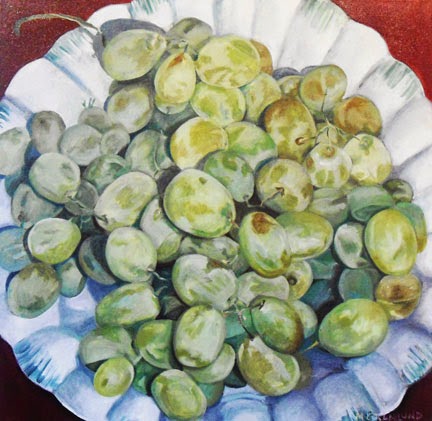
But our relationship to food has become so complicated, because it is such an intricate part of being human. We have a tendency to think of food as something separate from ourselves. There is a sense that as long as we put something in our bellies, especially things that taste good or make us feel good, our body will use that to maintain itself. But many things that we consume can not be digested or used by our bodies. Some things are actually detrimental to our health – even though someone else is telling us that it is healthy. In these paintings I am also exploring this complicated relationship with food.
What is the difference between eating fresh caught rainbow trout and fish-sticks? Physically, aesthetically, and socially? Why do we need an apple, the Arctic Apple, that does not brown when cut? Why do we need to pump chemicals into our environment in order to produce food? These are all questions and concerns that also inform this series of paintings.

I would love your feedback as I display images of my paintings here and invite you to come to any shows I will have.
Subscribe to:
Posts (Atom)