

Tuesday, December 14, 2010
Oil Painting: Mangoes

Wednesday, December 8, 2010
Oil Painting: Boiling Frog

Saturday, December 4, 2010
Oil Painting: Corn, Beans and Kale

Looking back I see that I have not posted the final image of Corn, Beans and Kale from the first story in The Book of Bartholomew. This is a 16" x 14" oil painting. Bon appetit!
Tuesday, November 2, 2010
Art Lesson: Vanishing Point
Vanishing points are a form of linear perspective that is used to create foreshortening or a sense of depth to an object. Here are a couple of examples as to how vanishing points work. With cylindrical shape, the seemingly parallel edges of the cylinder would meet at a point in the distance. The front of the cylinder would be a circle. The back edge of the cylinder should arc as if the back end was a circle also. So what in 3-dimensions is two same sized circles connected by two parallel lines becomes in a 2-dimensional drawing two different sized circles connected by two lines that eventually meet at a point. These are two very different things, but one represents what is while the latter represents what we see.


Monday, October 25, 2010
Art Lesson: Graphite Pencils
Here is a little history and information I have learned about graphite pencils.
History: http://www.wikipedia.org/wiki/Pencil
Important things to know about pencils:
Sharpening:
You can sharpen your pencils in a few ways. The easiest and most common is with a Pencil Sharpener. Like many tools, you get what you pay for. I like a pencil sharpener with a built-in container to hold the shavings. This makes it less messy. The problem with sharpeners is that they can loosen over time and get dull, thus being less effective. Electric pencil sharpeners seem to hold up well but if you are not near an outlet they are not practical.
Often I will use a knife to sharpen my pencils, especially when I work outdoors. Knives always give you a point that is sharp. For some people it is hard to work the knife just right without cutting off too much wood or graphite. This can also be a messy way of sharpening if you need a waste basket for the shavings. To sharpen with a knife you stroke the knife away from you, like whittling a stick.
Sandpaper can also be used to do fine sharpening of the graphite. I find this a bit messy and do not use this method much. I would rather spend my money on a decent pencil sharpener.
Problem - Graphite in pencil breaks often when sharpening
If your graphite keeps breaking as you are sharpening it, this is because at some point your pencil was dropped and the graphite inside shattered. Be careful not to drop your pencils on hard floors and surfaces.
Holding:
Your pencil should be held with what is called a dynamic tripod grip. The tripod grip means that there is equal pressure on the pencil from the tips of your thumb, pointer finger and middle finger. This grip gives the most flexibility while drawing.
I hope this information was helpful.
Keep using your Artist's Brain.
Wednesday, September 29, 2010
Art Lesson: Thumbnails, a Form of Protection
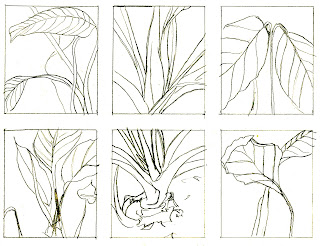
Where would we be without our thumbnails? We would be in pain and misery, that's where we would be. Our fingers would be wrapped in band-aids and nothing would ever get done. And that is the same place we would be without thumbnail sketches! Okay, maybe our fingers wouldn't be covered with band-aids, but we would be in pain and misery trying to complete an interesting drawing or painting. Thumbnail sketches are very valuable to the botanical or representational artist. It is in the thumbnail sketch (a small simple line drawing exploring composition and shapes) that:
- helps the artist explore the most effective and interesting view of their subject
- captures the energy of the first ideas behind the final composition
- defines the proportion of the final composition, and
- informs the artist what they need to observe, research or explore more deeply before investing lots of time into a project
I always first explore my compositions with thumbnail sketches, often done during boring meetings at work, and then expand them from there. To see an example of a book cover developed from a one inch sketch, click here.
Saturday, September 11, 2010
Illustration: Book Cover - Bartholomew Makes a Decision

 Here are images showing the progression for creating the cover for the first tale of The Book of Bartholomew. The first two sketches are my first ideas of what I wanted to paint: a plate of corn, green beans and kale. The first is very rough and was only about 1.25" square. The second image represents another plate of food with the words "KNOCK, KNOCK" on the cover. This is because Bartholomew is interrupted during his meal by a knock at the door. All Bartholomew wants to do is find some decent food and once he sits down to eat he is interrupted by the phone and the door.
  Then it was time to do some research. This meant enjoying a few meals of corn, geen beans and kale. I cooked the kale once and the other time my girlfriend cooked it. Hers was much better. We cooked the food and then I went to work rearranging it on the plate to somehow match what I wanted to do. I did not find my final composition, but it was fun and informative for the final painting. The food was good. I wish the green beans were from my garden. Today I could pick them and use them, but when I painted this picture beans were not in season.
I used these images to layout the composition of the painting and made the first layer of paint on canvas. From there I built up the surfaces and colors to create a finished painting of a plate of kale, corn and green beans. The cooked kale was the hardest to paint. It was hard to get a focused picture of it as its edges are rather soft and difficult to pick out.


After completing the painting, I took the image to Photoshop and added the words KNOCK KNOCK and the title. This was a fun stage - turning a painting into a book cover
The next step was to create a background for the inside text pages of the story. Continuing with a food theme, I created drawings of forks and spoons. These images line the text pages and are faded behind the text. This was a very fun story to illustrate. I like the idea of not showing Bartholomew or Gerald, but letting the reader develop their own physical image of the characters.
Subscribe to:
Posts (Atom)